
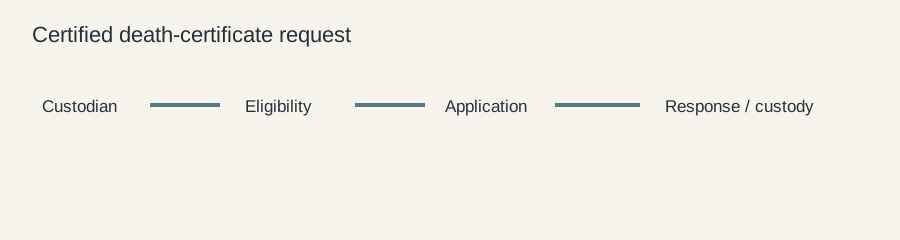
The practical problem in many estate files is not deciding what a death certificate proves. It is obtaining the correct copy, from the correct custodian, for a requester who can show the required authority, and preserving the response so another reviewer can tell which version was used. That is a records-request and chain-of-custody problem. It is distinct from a research article that interprets certificate fields, informants, residence, or amendments as evidence about an estate.
The Maryland Department of Health death was checked as a concrete official example. The page states that Maryland’s Division of Vital Records issues certified copies for people who died in Maryland in 2012 or later, directs older requests to the State Archives, identifies eligible applicants, and warns that a fee is not refunded when a record cannot be located. It also links the mail application, identification requirements, entitlement documentation, and payment instructions. Maryland’s rules do not control another jurisdiction; use the applicable registrar’s page for the estate at issue.
Define the copy the file needs
Before opening a request form, write the purpose in one sentence. A probate filing may need a certified copy for a court packet. A bank may need a copy to document notice. A title professional may need a copy as one item in an ownership review. Those uses can involve different copy types, authentication requirements, delivery addresses, and privacy restrictions. “Get the death certificate” is too vague to manage.
Record the decedent’s full known name, alternate spellings supplied by the file, date and place of death, jurisdiction believed to hold the record, number of copies, intended recipient, and deadline. Keep the requested fields separate from assumptions. If the file has only a hospital location, do not treat that as the place of death until the custodian’s rules or another source confirms the jurisdiction.
Identify the responsible custodian
Vital records are administered by jurisdictions, not by one universal national index. Start with the state or local registrar’s official site. Confirm whether the death occurred inside the jurisdiction, which years the office holds, whether older records moved to an archive, and whether online, mail, or in-person requests are available. Save the page title, URL, checked date, and the rule that led to the selected custodian.
The Maryland example is useful because its page separates records from 2012 or later from older records held elsewhere. That is a routing rule, not an identity conclusion. If an office says it cannot locate a record, preserve the response and ask whether it will issue a record-search certification. Do not rewrite “not located by this office” as “no death record exists.”
Verify requester eligibility before paying
List the applicant’s relationship, fiduciary appointment, authorization, or other entitlement basis. Attach only the documentation the official instructions require and transmit it through the custodian’s approved channel. If the estate is represented by an attorney or personal representative, distinguish the authority of the requester from the identity of the decedent. A requester can be properly authorized and still have supplied the wrong jurisdiction or date.
Create a preflight checklist: application complete, applicant identification copied as required, entitlement document attached, death details checked against the estate file, fee method accepted, delivery address confirmed, and number of copies recorded. If the office uses a vendor, capture the vendor name and any additional fee separately from the government fee. A payment receipt proves payment; it does not prove that the correct record was ordered.
Worked example: routing a Maryland request
Assume the estate file says that Jordan Lee died in Maryland in 2018, but the only supporting paper is a funeral-home invoice from a neighboring state. The request log should first record the uncertainty about place of death. If a Maryland record is appropriate, the official page indicates that the Division of Vital Records handles Maryland deaths in the stated period and identifies who may apply. The researcher saves the page, selects the authorized requester, completes the application, attaches the required identification and entitlement materials, and records the receipt.
Now suppose the custodian cannot locate the record. The log should preserve the application date, search details, fee, response wording, and any search certification. It should not say that Jordan Lee had no certificate. The next action might be to verify the place of death, consult the older-record archive if the date was misunderstood, or ask counsel whether another certified record will satisfy the filing purpose. Each action tests a different failure point.
Preserve the request and the response as separate records
Use one row for the request and another for the custodian’s response. The request row records what was asked, by whom, when, through which channel, and with what attachments. The response row records the date, tracking number, copy type, pages or certificate number when permitted, delivery condition, and any limitation or rejection. Do not overwrite the request with a later corrected application.
When the copy arrives, compare the envelope or secure download metadata with the order, scan the document according to the organization’s records policy, and record the working-copy hash if an auditable handoff requires it. Label the controlled original and any redacted review copy. If a vendor or mail service supplied tracking, preserve the tracking event without implying that delivery proves the certificate’s contents.
Handle a mismatch without silently reordering
If the received copy has a different spelling, date, jurisdiction, or number of copies than expected, stop the handoff and create a discrepancy note. Quote the field, identify the expected value and its source, and state whether the difference may result from the registrar’s format or a substantive mismatch. Ask the custodian the narrowest correction question possible. A new order should have a new identifier; do not edit the first request to make it appear successful.
The same discipline applies to an amended or replacement copy. Record which version arrived first, what the later copy changes, who supplied it, and which professional or filing will rely on it. This article’s subject is the request trail. Whether the changed field affects identity, domicile, title, or tax treatment belongs in a separate evidentiary analysis.
Make the handoff reproducible
The final packet should contain the official custodian page, request form or portal confirmation, eligibility basis, payment and tracking records, response, copy version, retrieval date, and unresolved routing questions. Use descriptive file names that include the request identifier and version, not only the decedent’s name. Restrict personal information to the approved workspace and redact copies prepared for broader circulation.
A second reviewer should be able to answer five questions without asking the original researcher: Which office was selected and why? Who was entitled to apply? What exactly was requested? What did the custodian return or say? What remains open? If any answer depends on memory rather than a saved record, the request log is incomplete.
Limits and professional ownership
An official request page can establish routing, eligibility, forms, fees, and response procedures. It cannot establish facts about an individual decedent and cannot decide whether a copy satisfies a court, bank, title, tax, or fiduciary requirement. Record those external requirements separately and ask the responsible professional to confirm them before relying on the copy.
The researcher’s conclusion should therefore be operational: the request was sent to the selected custodian, the stated authority and payment were supplied, the response was received or remains outstanding, and the next action is known. Keep any conclusion about what the certificate proves in the evidence review for the particular estate.
Record the returned copy without overclaiming
When the certificate arrives, log the delivery date, sender or secure portal, copy type, number of pages, certificate or file identifier, and any visible certification statement. If a packet contains a cover letter, separate the letter from the certificate and preserve both. A returned document can be authentic yet still be the wrong jurisdiction, an informational copy, or an incomplete response to the order. Ask the responsible professional whether the copy satisfies the intended filing or transfer purpose; the request log should show the answer and the reason.
This final custody check closes the operational workflow. It does not decide what the certificate proves about identity, domicile, property, or tax treatment.
Frequently asked questions
Does paying the fee prove the request was valid?
No. Payment records show payment. Eligibility, jurisdiction, and the custodian’s response must be documented separately.
What if the office cannot find the record?
Preserve the exact response and search certification if offered. Recheck jurisdiction and dates; do not claim that no record exists everywhere.
Should the request log include the full certificate?
The controlled estate record should preserve the returned copy under the organization’s privacy and retention rules. Public or broad-review copies should be minimized or redacted.
Is this a determination of identity or domicile?
No. It is a reproducible request and custody workflow. Professionals decide the evidentiary and legal effect for the matter.