
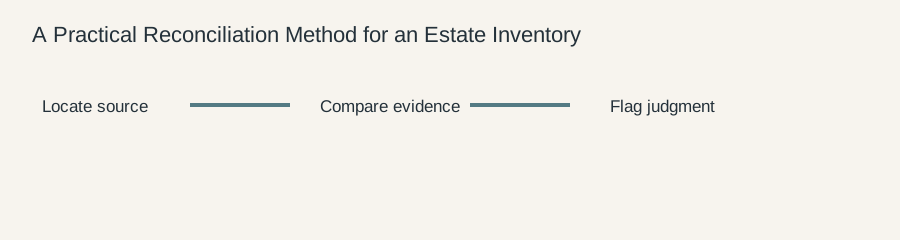
An estate inventory is useful because it turns a scattered file into a list of people, accounts, parcels, vehicles, claims, and obligations. It is risky when a reviewer treats the list as a final statement of what exists. Inventory rows are often assembled from interviews, statements, deeds, tax records, prior schedules, and correspondence collected at different times. A good reconciliation does not make every row look tidy. It shows which documentary source supports each row, which source conflicts, and what the personal representative or professional still needs to decide.
This article describes a records workflow, not a valuation, title opinion, tax position, or fiduciary conclusion. The Instructions for Form 706 (Rev. September 2025) was checked for the distinction between estate-reporting questions and ordinary file organization. The IRS source does not determine the value or tax treatment of a particular asset.
Start with a row-level proposition
Do not begin by comparing totals. Begin with a proposition for one row: “The brokerage account listed as ending 4482 existed at the relevant date and belongs in the account schedule.” That proposition can be tested against a statement, a custodian letter, a transfer-on-death designation, and the date of death. A different row may ask whether a parcel description matches the deed, or whether an insurance refund is an asset or a post-death receipt.
Give every row a stable identifier that is not just its description. “Main Street house” is a label; “parcel 18-04-006, deed instrument 2010-4412” is a documentary key. For financial items, preserve the last four digits but keep sensitive full numbers in the controlled file. For claims, use the claim number and claimant. Add an owner or capacity field: individual, joint owner, trust, company, personal representative, or unknown.
Build the evidence columns
A useful reconciliation sheet has columns for inventory description, stable identifier, source type, source date, observed fact, amount or interest, confidence limited to the evidence, discrepancy, next action, and professional owner. The “observed fact” cell should quote or closely transcribe the source. The “analysis” cell should explain why that fact is relevant. Keeping those fields separate prevents an estimate from being mistaken for a statement balance.
For each row, link the source file or stable URL. Record whether the source is primary, corroborating, or merely a lead. A bank statement is primary evidence of what that statement reports; an heir’s email saying an account existed is a lead; a tax return may corroborate income or ownership but may not establish current title. The classification depends on the proposition being tested.
Worked example: a property row that does not reconcile
Suppose the inventory lists “12 Oak Road — $410,000,” a tax bill lists parcel 11-22-014, and a recorded deed names the decedent as owner of Lot 3, Block 2, Oak Addition. A current assessor page displays parcel 11-22-014A and a value of $385,000. The first temptation is to replace the inventory value with the assessor value. That is not reconciliation; it is substitution.
The researcher should compare the legal description, parcel history, assessment year, and any split or combination instrument. The two values may answer different questions. The deed may cover a partial interest, the assessor may have changed the parcel, or the inventory may reflect an appraisal date. The resulting row can say: “The deed and historical parcel reference are consistent with the property lead; current parcel suffix and valuation basis require title and appraisal review.” That conclusion is more useful than a falsely precise total.
Financial accounts require date discipline
A statement balance is tied to a statement period, not automatically to the date of death. A later statement may show an account that was open earlier, but it can also include deposits, withdrawals, interest, or transfers after death. Record statement date, period end, account title, owner or capacity, and balance separately. If the statement is a joint account, do not decide the estate’s includible portion from the label alone.
When an account disappears between two statements, create a discrepancy row. Ask whether it was closed, transferred, retitled, merged, or omitted from the later production. Search the correspondence and custodian letter. If a transfer-on-death designation or beneficiary claim is involved, flag it for counsel rather than treating the asset as either estate or non-estate property by default.
Reconcile liabilities and receipts separately
An inventory often mixes assets, debts, expenses, refunds, and post-death receipts. Use separate categories. A funeral invoice is not the same kind of evidence as a refund check. A property-tax bill may include a period before and after death. A credit-card statement may show charges that require a fiduciary decision. Preserve the source and allocate dates without deciding legal responsibility.
For each payment, capture payer, payee, amount, transaction date, service period, account used, and supporting invoice. Do not net a refund against an expense merely because the amounts are similar. A net total hides the audit trail and makes later correction difficult.
Handle missing rows without inventing assets
If a professional expects a bank account and it is absent, document the search rather than creating a placeholder balance. Record institutions contacted, search terms, known addresses, response dates, and any request limitations. “Not located in the searched records” is an appropriate interim result. It is not proof that no account existed.
If a row has no source, classify it as reported, unverified, or disputed. Preserve who supplied the report and when. A reported asset can be a valuable lead, especially when the description contains an account fragment or a former address. It becomes misleading only when the label is allowed to enter the supported total without its limitation.
Use independent cross-checks
Choose a cross-check that tests the row, not one that repeats it. A deed can be compared with a parcel history; a brokerage statement with a custodian letter; an insurance policy with a premium payment; a vehicle title with the registration record. Explain what the second source can and cannot establish. A matching address supports identity; it does not establish ownership of every item delivered there.
Document conflicts in plain language. “The inventory says joint ownership; the statement displays one name” is better than “ownership unclear.” The next action might be to obtain the account agreement, title record, or attorney review. Each open question should have a responsible owner and a requested document.
Quality review before delivery
Recalculate totals from the row-level evidence only after categories and limitations are stable. Check duplicated identifiers, impossible dates, negative amounts, post-death transactions, missing source links, and rows that appear in both asset and liability schedules. Confirm that every adjustment has a reason and a source. Have a second reviewer reproduce one supported row, one conflict, and one negative search.
Before delivery, confirm that the handoff distinguishes an amount reported by a source from an amount selected for a professional schedule. That distinction keeps the research record useful when a later appraisal, accounting review, or tax decision changes the treatment of a row.
A row-level review example
For a retirement account row, preserve the statement period, account title, owner capacity, balance, and custodian response separately. A later transfer letter may explain why the account is absent from a final statement, but it does not by itself establish who received the funds. The reconciliation conclusion should identify the last supported observation, the event that is missing, and the professional question. This prevents a spreadsheet total from hiding a gap that matters more than the arithmetic.
The reviewer should preserve the source amount and the reason any schedule amount differs. That makes later accounting corrections traceable.
Reconcile by proposition, not by row count
When an inventory row and a source disagree, identify the proposition that the row was meant to support before changing either value. A parcel row may establish identity, while a deed establishes the recorded interest and a tax account supplies an administrative identifier. Those are related but not interchangeable. In a worked review, preserve the original row, create a discrepancy entry, and cite the exact source field that caused the conflict. Then state whether the discrepancy changes the inventory, calls for a new request, or is only a naming difference. This approach prevents a clean-looking spreadsheet from concealing an unresolved ownership or valuation question.
Frequently asked questions
Does a statement prove the estate owns the balance?
It proves what the statement reports. Ownership, survivorship, beneficiary effect, and tax treatment require professional analysis.
Should unsupported rows be deleted?
No. Label them as reported or unverified, preserve the lead, and document the next search.
Can two similar amounts be netted?
Not without a documented accounting reason. Preserve receipts and expenses separately first.
What is a useful reconciliation conclusion?
State which rows are supported, which conflict, what was not located, and who must decide the unresolved issue.