

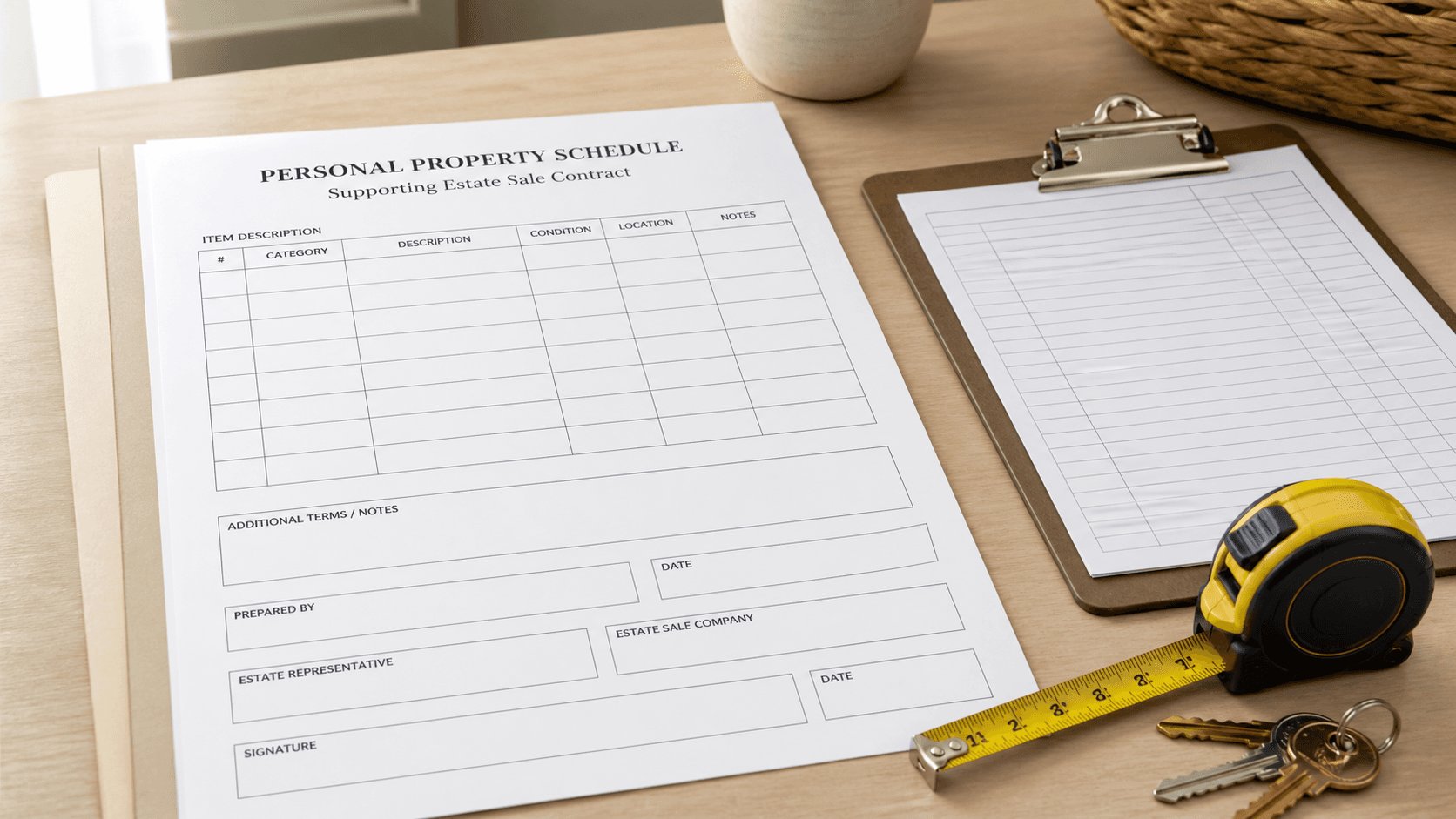
An estate sale contract may refer to furniture, appliances, tools, artwork, vehicles, or other personal property in a schedule that is incomplete, inconsistent, or difficult to identify. A careful review ties each item to a source, location, condition description, and disposition instruction. The purpose is to help the responsible professional understand what the documents say and where the record needs clarification, not to appraise an item or decide ownership.
**Published August 21, 2026**
Define the schedule’s purpose
Determine whether the schedule transfers items, excludes them, records them for inventory, or simply describes what remains at the property. Read the attachment and the main agreement together. Note incorporation language, signatures, dates, and whether the schedule is expressly part of the bargain. A checklist labeled “personal property” may not have the same role as a signed exhibit, so document the distinction.
Use stable item identifiers
Names such as “dresser” or “lawn equipment” may describe several objects. Create an item identifier and record room, approximate position, manufacturer or model when visible, serial number if present, and photograph reference. Do not add a serial number from memory or a secondary listing. If an item cannot be uniquely identified, mark it as ambiguous and describe the comparison needed.
Compare schedule with the premises
Walk the schedule against the property photographs, inspection record, inventory, and closing instructions. Record present, absent, moved, damaged, or not verified. A photograph can show presence at capture time but not ownership or contractual inclusion. Keep the observation and the contractual question in separate columns. This prevents a visual match from becoming an unsupported statement that an item must be delivered.
Separate fixtures from personal items
Some objects are described by function while the contract treats them differently. Compare references to attached equipment, built-ins, appliances, landscaping items, and removable goods. If the documents use a defined term, cite it. If classification is disputed, state the physical facts and route the legal or transactional interpretation. A reviewer should not settle a fixture question simply because an item is heavy or connected to the property.
Record condition without grading value
Use neutral observations: cracked, stained, incomplete, powered on, not tested, or condition not visible. Record the date and source of each observation. Avoid language such as excellent, worthless, or marketable unless a qualified source actually supports it. The contract review needs to show what the packet says and what the inspection found, not create an appraisal or warranty.
Track excluded and reserved items
An estate may reserve family photographs, documents, firearms, vehicles, sentimental objects, or items destined for another beneficiary. Index exclusions with the same care as included goods. Confirm where the exclusion appears and how removal is to occur. If a reserved item remains at closing, create a handoff question. This reduces the chance that a vague “seller belongings” clause will be used to hide a material omission.
Reconcile delivery and possession
Link each included item to delivery location, possession date, key or access arrangements, and any packing or removal responsibility. If the agreement permits substitutions, record the approval process. Preserve receipts or photographs from the handoff. A later claim that an item was missing is easier to investigate when the file shows whether it was ever verified and who controlled access.
Close the schedule deliberately
A final schedule should show item status, evidence, unresolved discrepancy, and owner. Do not delete a disputed line; mark it open and preserve the underlying source. If a professional approves an amendment, index the signed version and note which earlier row it changes. The completed packet should tell a new reviewer what transferred, what was excluded, and what question remains.
Questions to carry into the next review
For this estate sale personal property schedule review, begin by asking which document supplies the fact, which event gives it meaning, and which person owns the next question. That order matters when an estate file contains a signed agreement beside drafts, summaries, messages, and records downloaded at different times. Keep the source name and retrieval date beside each observation. If a source uses a different property identifier, party name, or date, preserve the difference and explain the comparison that would resolve it. A note that says “not located” should identify where the search looked and who can supply the missing item. A note that says “confirmed” should point to the page, entry, image, or receipt that supports it.
The review should also state its limits. It may organize contract language, authority evidence, property records, delivery history, or payment documents, but it does not decide enforceability, title, tax treatment, insurance coverage, valuation, or a remedy. Those questions belong to the qualified professional responsible for the matter. Use the Real Estate Transaction Contracts lens to keep the handoff practical: name the open issue, preserve the record, and give the next reviewer enough context to act without repeating the entire search. Keep later amendments, corrections, and newly retrieved records in date order so the file remains understandable when the matter changes hands.
A review worksheet
Use one row per item or clearly defined group, with columns for item ID, contract reference, location, source image, condition observation, inclusion status, exclusion note, delivery event, and unresolved question. Run a duplicate check on serial numbers and photographs, then compare the final schedule to the signed exhibit. Keep inventory work separate from title, valuation, tax, and ownership opinions.
Closing perspective
Personal property review is a matching exercise with boundaries. Clear identifiers, neutral condition notes, and an explicit handoff let an estate contract file answer practical questions without pretending that a schedule alone resolves title or value.
This article is general educational information, not legal, tax, title, insurance, or accounting advice. The agreement, authority documents, facts, and governing jurisdiction control.