
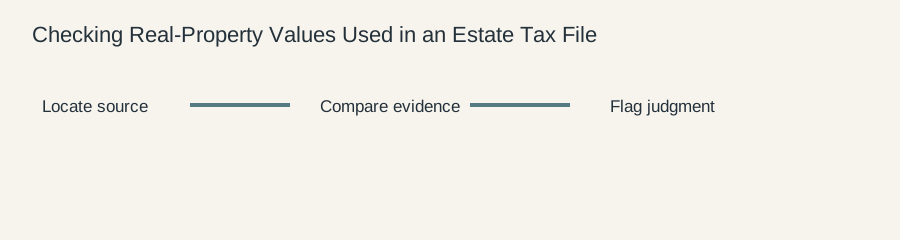
Real property can appear in an estate file with several different numbers: an assessor’s value, a tax-roll amount, an appraisal, a sale price, a broker opinion, an insurance value, or a figure typed into an inventory. Those numbers may each be accurate for their own purpose. They are not interchangeable. A records review should identify what each number measures, which date it belongs to, what interest it describes, and whether a qualified professional has selected it for the tax question.
The Instructions for Form 706 (Rev. September 2025) was checked. It provides federal filing context; it is not an appraisal instruction for a particular parcel. This article organizes evidence and uncertainty. It does not give tax, appraisal, title, or legal advice.
Name the valuation proposition
Begin with a sentence narrower than “what is the house worth?” For example: “What documentary value evidence is available for the decedent’s one-half interest in parcel 11-22-014 as of the required valuation date?” That wording identifies parcel, interest, and date. It also leaves room for the appraiser or tax professional to decide which evidence is appropriate.
Create a value table with source, field label, date type, parcel or legal description, interest, amount, purpose, and limitation. Copy the source’s label exactly. “Taxable value,” “assessed value,” and “estimated market value” should not be compressed into “value.” Preserve a later analysis in a separate field.
Check the property before checking the amount
Match the deed’s legal description to the assessor parcel, tax account, plat, and current map. A street address is a useful lead but can change. A parcel can split or combine. A deed can cover a partial interest while the tax account covers the whole tract. If the property identity is uncertain, a precise-looking amount is not useful evidence.
For a condominium, capture unit, building, declaration, phase, and common-element reference. For rural land, preserve acreage, metes-and-bounds calls, and reservations. For a trust or entity, capture capacity and interest rather than assuming the decedent owned the whole parcel personally.
Worked example: five numbers and one question
Assume an inventory reports $600,000 for a residence. The 2024 assessor record shows $410,000 assessed value; an insurance policy lists $720,000 replacement cost; a 2023 appraisal says $565,000; and a contract signed after death has a $590,000 price. Each number answers a different question. The insurance figure concerns replacement coverage, not necessarily land and market value. The tax figure follows local assessment rules. The appraisal has an effective date and assumptions. The later contract may provide market evidence but is not automatically the requested date value.
The research handoff should list all five figures, source dates, parcel match, interest, and limitations. It should not choose the number that best supports a desired tax result. Ask the appraiser or tax professional which source is relevant and whether additional valuation work is required.
Date discipline matters
Separate date of death, appraisal effective date, assessment date, certification date, contract date, closing date, recording date, and retrieval date. A 2024 tax roll may be certified months after its assessment date. A sale after death may reflect changed market conditions. A deed recorded after death may have been executed earlier, but the legal effect belongs to counsel.
If the file uses an alternate valuation concept or another reporting date, record the request exactly and route it to the tax professional. Do not infer the controlling date from the year printed on a bill. If a source does not state its valuation date, mark that limitation.
Interest and condition are separate fields
A value for the whole property is not automatically a value for a one-half interest. A life estate, remainder, tenancy, mineral reservation, conservation restriction, lease, or easement can affect the professional analysis. Similarly, an appraisal’s condition assumptions may differ from the property condition shown in inspection, repair, or insurance records.
Record the interest shown by the deed and the condition described by the source. Do not calculate a fractional amount by multiplying a whole-property value unless the appraiser or tax professional requests that method. A simple arithmetic adjustment can ignore discounts, restrictions, or separate interests.
Compare sources without averaging them
A reconciliation is not an average. Compare parcel, date, purpose, interest, source method, and assumptions. If an appraisal and sale price differ, investigate timing, financing, repairs, personal property, concessions, or changed condition. If a tax roll and deed disagree about acreage, retrieve the plat or later instrument. If a broker opinion lacks a stated effective date, record the omission.
Use an evidence status such as supported, contextual, conflicting, incomplete, or not located. The status should explain the source relationship. “Conflicting” does not mean one source is wrong; it means the numbers cannot be combined without professional analysis.
Protect against false precision
Keep source amounts exactly as reported and identify currency and units. Do not round before recording. Derived calculations should show formula, inputs, and purpose. If a spreadsheet calculates a percentage change between assessment years, label it as an analysis and confirm the parcel and field are comparable. A calculated result is not a new source fact.
When a source is missing, document the custodian, request, date range, response, and limitation. “Appraisal not located” is different from “no appraisal exists.” A public tax record can be saved as evidence of what the county displayed, but it does not replace a requested appraisal.
Handoff and integration
Review the valuation packet as a set
Ask whether the appraisal identifies the same parcel and interest as the deed. Check the effective date, intended user, assumptions, comparable-selection explanation, and any extraordinary assumptions. A broker letter or sale contract may supply context but should be labeled by its purpose. If a tax return contains a number that differs from the appraisal, preserve both and ask the tax professional whether the difference reflects a reporting method, later information, or an unresolved error.
A reviewer should be able to trace every value in a schedule to a source and every source to a date and interest. That trace is more valuable than a table that contains one apparently authoritative number without its basis.
If an appraisal is pending, do not fill the gap with an assessor number and leave the substitution unexplained. Mark the row awaiting appraisal, retain contextual public records, and state which professional owns the next action. If the professional later selects a value, preserve the selection memo and keep the underlying sources so the schedule remains auditable.
Also record the purpose for which each number was supplied. A figure prepared for insurance, lending, a local assessment, a sale negotiation, or a federal return may use different assumptions. Listing purpose beside amount prevents a later spreadsheet user from treating a convenient number as a universal value.
The source packet should identify who supplied each number and whether it was independently reviewed. That provenance matters when a schedule is amended or professionals rely on different versions of an appraisal.
Keep that provenance beside the amount.
Document assumptions before comparison
Two values cannot be compared responsibly until the file records interest, condition, date, and purpose. A whole-property appraisal, a fractional inherited interest, and a tax assessment may all carry different assumptions. Preserve the source labels and ask the appraiser or tax adviser which comparison is meaningful. A clean table with mismatched assumptions is less reliable than a table that displays an unresolved difference.
Keep the selected value linked to the professional’s dated instruction and the underlying appraisal or source record. Record that relationship clearly.
Reconcile a value disagreement without choosing a winner prematurely
Suppose a county record shows $410,000, an appraisal shows $565,000, and a post-death contract shows $590,000. The review should first test parcel identity, ownership interest, effective date, purpose, and transaction terms. If the contract includes personal property or unusual financing, its price cannot be treated as a clean comparable without analysis. If the appraisal assumes repairs that were never made, that limitation travels with the number. Preserve all three amounts, classify the disagreement, and ask the responsible professional which valuation question controls. A transparent unresolved difference is more useful than a false single-value answer.
Frequently asked questions
Is an assessor value the estate-tax value?
Not automatically. It is a local assessment record with its own method and date.
Can a later sale prove the date-of-death value?
It may be relevant evidence, but timing, condition, terms, and professional method matter.
Does a whole-property appraisal establish a fractional interest value?
No. The interest and any restrictions require professional analysis.
Who selects the value used for a filing?
The responsible tax professional, appraiser, attorney, or fiduciary.