
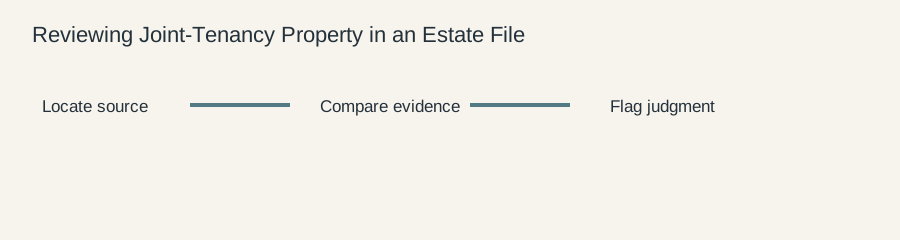
The phrase “joint tenancy” can make an estate file appear resolved before the underlying title records have been reviewed. A deed may use survivorship language, a tax roll may list two names, an affidavit may be recorded after death, and an inventory may include the full property. Those records answer different questions. The research task is to reconstruct the title and event sequence without deciding legal effect, survivorship, creditor rights, tax treatment, or whether a later instrument changed the interest.
This article is a records workflow, not legal or title advice. The MDLandRec Search Aid Guide was checked for recorder access context. Local law and a title professional control the analysis.
State the title proposition
Write the proposition before searching: “What interest did the recorded documents display before and after the death, and which document should counsel review for survivorship effect?” Avoid “the property passed automatically.” That is a legal conclusion. Identify parcel, deed, parties, recording date, death date, and any known affidavit or transfer.
Preserve the exact vesting language. “Joint tenants with right of survivorship,” “tenants in common,” “community property,” and a bare list of names are not the same text. A tax roll’s two-name display may be an administrative label rather than a complete vesting statement.
Build the title chronology
Start with the last deed known to predate death. Capture grantors, grantees, capacity, legal description, consideration language if shown, recording data, and every exception or reservation. Then search forward for death-related affidavits, survivorship affidavits, deeds, releases, probate filings, and later conveyances. Give each event its own date type: execution, acknowledgment, recording, death, or retrieval.
Do not use the recording date as the death date or the effective date without professional analysis. A document signed earlier may be recorded later. A document recorded after death may be a later administrative filing rather than a new transfer.
Worked example: two names on a tax roll
Suppose a tax roll lists “Avery Chen and Jordan Chen,” the 2009 deed says “Avery Chen and Jordan Chen, as joint tenants,” and Jordan dies in 2024. The inventory omits the parcel because a family member says it passed to Avery. The recorder later shows an affidavit of survivorship.
The research packet should preserve the deed, tax record, death certificate if available, affidavit, parcel crosswalk, and subsequent title search. It can state that the deed and affidavit display specified names and language and that the tax roll lists the parcel. It should not state that Avery owns the property free of every claim. Counsel must evaluate survivorship, notice, execution, recording, creditor issues, and applicable law.
Change the deed. If it says “Avery Chen and Jordan Chen, tenants in common,” the same death and affidavit do not create the same documentary trail. The affidavit may be a lead or a disputed instrument. Preserve the conflict and ask title counsel what additional court or recording evidence is needed.
Distinguish title from administration
An asset can be relevant to an estate file even when it does not pass through the probate inventory in the same way as solely owned property. The researcher should not remove every joint-tenancy parcel from the workpapers without recording the source and professional decision. Keep a disposition field such as “reported survivorship; legal effect pending review.”
Separate questions may include whether the decedent contributed funds, whether a severance occurred, whether a spouse or trust was involved, whether a lien or mortgage affects the property, and whether a later conveyance changed the interest. A deed search can expose records; it cannot answer every question about beneficial ownership or tax inclusion.
Check the legal description and interest
Match the joint-tenancy deed to the parcel using legal description, plat, parcel number, and prior deed. A street address can identify the likely property but not prove that every parcel component is included. Check for a partial tract, condominium unit, mineral interest, easement, life estate, or reservation.
Read the capacity of each party. A trustee, personal representative, agent, or entity may appear beside individual names. A signature block can reveal a different capacity than the grantor-grantee index. Preserve the image and cite the page rather than relying on an index label.
Search for changes and severance clues
Search subsequent deeds, corrective instruments, affidavits, divorce or partition references where authorized, mortgages, releases, and court filings. Search name variants and entity names. A missing result should include custodian, date range, parcel, name forms, instrument types, and portal limits.
Do not treat a later deed as proof that the earlier deed was invalid. Do not treat an affidavit as proof that every statutory requirement was met. Document the event and route the legal consequence to counsel or the title professional.
Evidence table and conclusion
Use columns for document, parties, capacity, vesting text, parcel, date type, recording data, source path, and unresolved question. Label each statement fact, analysis, or uncertainty. Fact: “The deed image contains the phrase shown.” Analysis: “The parcel description is consistent with the tax account.” Uncertainty: “The affidavit’s legal effect and any creditor issue have not been evaluated.”
The conclusion should say what documents were found, what they display, what was not located, and who must decide the effect. Avoid “automatically inherited,” “cleared,” or “not an estate asset” unless a responsible professional has made that determination.
Handoff and integration
A second-review test
Have a second reviewer locate the vesting phrase in the deed, the parcel identifier in the tax record, and the date and capacity in the post-death filing. Then ask the reviewer to state only what those three records display. If the reviewer reaches a legal conclusion from the records alone, revise the handoff so the professional question is visible. This test catches the common error of turning a title clue into a result.
Keep a separate row for liens, mortgages, restrictions, and partial interests. Survivorship language may address one ownership question while leaving other burdens or interests untouched. A complete research packet should make those branches visible.
When a later professional conclusion changes the disposition, update the conclusion field without deleting the original observations. The record should show what was found, what was inferred, and what judgment was eventually made.
Include the document number and recording office in that conclusion. A later reviewer must be able to distinguish a recorded affidavit from a family summary or a tax-roll label, especially when several parcels share an address.
Retain the source image and retrieval date. A portal display can change while the underlying instrument remains the evidence used for the conclusion.
Add the recording office, instrument number, and page reference. These fields let counsel locate the original even if the online index changes, and they keep a family summary from being mistaken for a recorded vesting instrument. If a later document changes the apparent interest, preserve the earlier title record and explain the sequence rather than replacing it silently.
Record the retrieval date too.
Store it with the source hash.
Keep it immutable.
Look beyond the survivorship label
A survivorship phrase is one part of the title record. Check whether the instrument covers the whole parcel, whether another deed later changes the interest, and whether a mortgage, easement, or restriction remains. Preserve post-death filings without treating them as self-proving. The useful conclusion says what the deed and affidavit display and identifies the legal question that counsel must answer.
The title packet should make the remaining legal question visible instead of hiding it in a status label.
Build a title sequence before drawing a disposition conclusion
For a joint-tenancy review, place the vesting deed, later conveyances, mortgages, releases, affidavits, and relevant court filings in date order. Record the parties’ capacities and the legal description on each instrument. A later affidavit may describe survivorship, but the sequence can reveal a prior transfer, a partial parcel, or a different capacity that requires professional review. In a hypothetical file, the deed covers the residence, a later instrument covers only the garage parcel, and the tax account combines both. The correct conclusion is not “the title is clear”; it is that the combined tax account cannot by itself establish the disposition of both parcels.
Frequently asked questions
Do two names on a tax roll prove joint tenancy?
No. Review the recorded vesting instrument.
Does an affidavit of survivorship settle every issue?
No. It is a record to review, not a substitute for legal and title analysis.
Should a joint property be deleted from the estate file?
Keep the evidence and document the professional disposition decision.
What is the researcher’s role?
Organize the title trail, identify gaps, and preserve uncertainty; professionals decide legal effect.