
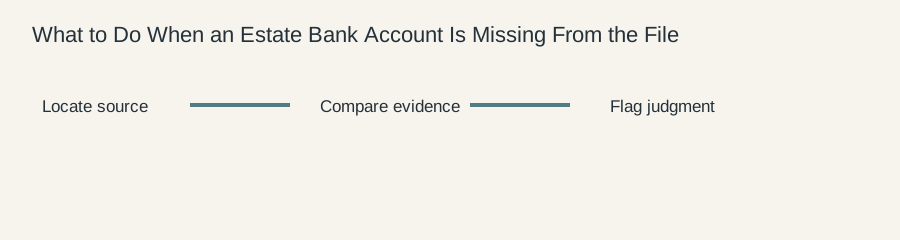
An estate file can contain a canceled check, an account fragment, or a family member’s recollection of a bank account without containing a statement that proves the balance or owner. The wrong response is to invent a balance, delete the lead, or announce that no account exists after one unanswered request. The better response is a bounded gap search: identify the proposition, preserve the clue, search the appropriate custodians, document limits, and escalate questions about ownership, survivorship, beneficiary designations, or fiduciary duty.
This article concerns records organization, not subpoenas, discovery strategy, tax advice, or legal conclusions. The Bank accounts and services was checked; it is relevant to professional reporting context, not proof that a particular account belongs in a particular estate.
Define what “missing” means
“The account is missing” may describe several situations: the inventory mentions it but no statement was produced; a statement shows an account and later records stop; a check names a bank but not an account; a custodian declined to search; or a beneficiary claim appears without the original account file. Put the precise situation in the gap register. Do not use one status for all of them.
Write a proposition such as: “Was account ending 4482 open on the date of death, and what record establishes its title or beneficiary treatment?” Then list the known bank, account fragment, names, addresses, dates, branch, employer, relationship manager, and source of the clue. A recollection is still worth preserving; it simply has a different evidentiary status from a statement.
Start with the strongest clue
Search the file for statements, tax forms, interest reports, canceled checks, wire confirmations, safe-deposit references, correspondence, and fiduciary accounting entries. Record the exact date, account fragment, institution name, and person or entity named. A check may identify the paying bank but not the owner. A tax form may show interest but be issued to a trust or joint owner. A letter may reference an account that was closed before death.
Use a clue table with columns for source, date, exact wording, identifier, apparent capacity, and follow-up. Preserve a scan or stable file path. Do not rewrite a partial number as a full number. Do not expose full financial identifiers in a public-facing document.
Worked example: the account that disappears
Suppose a 2022 statement shows an account ending 4482 in the decedent’s name. A 2023 inventory does not list it, and a bank response says “no responsive accounts” without describing its search. The file also contains a transfer letter dated two months before death. The correct next step is to request the missing period, the closure or transfer record, and the capacity in which the recipient acted.
Several explanations remain possible: the account was closed and paid out; it was retitled; it was transferred to a beneficiary; it was merged into another account; or the bank searched the wrong name or date. The researcher should not choose one because it makes the inventory balance. Report the documentary fact—the earlier statement and later response—and identify the unresolved event.
A different case contains only a check from a regional bank, payable to a contractor, drawn on an account with no visible owner. Search the estate’s papers for the same bank and date range, but do not attribute the account to the decedent without corroboration. Ask the bank what authorization and identifiers it needs to search. If it cannot search, classify the request as limited, not negative.
Search custodians in a deliberate order
Begin with institutions already named in primary file materials. Search known names and variants, including a trust, company, or former surname only when the file supplies a reason. Use a narrow date range around the clue before widening it. Record the query, response, and limitations.
Then consider related custodians: the personal representative’s accounting file, a tax preparer’s workpapers subject to applicable authority, a prior fiduciary, a broker that received a transfer, or a state unclaimed-property office. Each search answers a different question. A state unclaimed-property result can be a lead; it does not by itself establish entitlement. A tax transcript can corroborate interest income; it does not prove the account balance at death.
Do not send the same vague request to every institution. Ask for statements, opening and closing dates, ownership or capacity as legally disclosable, transfer or beneficiary records, and the custodian’s search boundary. Let counsel decide what authority or process is appropriate.
Separate ownership from balance
Even a statement with a balance does not answer every estate question. A joint account may involve survivorship rules. A trust account may belong to a separate legal arrangement. A payable-on-death designation may change the administration path. A business account may not be the decedent’s personal asset. Capture the displayed title and capacity exactly, then route the legal effect to counsel.
Dates also need labels. Statement period end, transaction date, closure date, transfer date, date of death, and request date are not interchangeable. A later statement can show a prior account without proving the balance at the earlier date. A closure letter can explain disappearance without resolving the destination of funds.
Make negative results reproducible
Record institution, department, authorization, name forms, account fragments, date range, record types requested, method, response date, result, and limitation. “No account found” is incomplete if the bank searched only the fragment supplied or only its current system. Say “not located in the bank’s stated search” when that is all the response supports.
If no response arrives, mark the request outstanding. If an email bounces, mark delivery failure. If the institution requests a court order or representative authorization, mark that requirement. These statuses preserve the difference between absent evidence and an unfinished task.
Reconcile the search with the accounting file
Compare the missing-account lead with the fiduciary accounting, deposit records, tax workpapers, and closing statements where access is authorized. A deposit into an estate account may show that funds arrived without proving the source account’s ownership. A check paid to the estate may be a refund, distribution, or transfer. Preserve the transaction description and ask the professional to classify it.
If the search reveals a new institution, create a new request row rather than editing the original bank request. Link the discovery to the clue that produced it and retain the date discovered. This prevents a later reviewer from believing that the first institution was searched under information that was not yet known.
Keep the original clue with the new row, because a later account match is not proof that every earlier clue referred to that same account.
Document the professional handoff
The handoff should contain the clue table, request log, statements, responses, timeline, and a short issue memo. Lead with facts: what source names the account, what the custodian said, and what dates are visible. Then state analysis and uncertainty separately. Ask counsel or the fiduciary whether the next step is a formal request, an accounting entry, a tax review, or closure of the lead.
Add the last search date and the person responsible for the next request. A gap without an owner can remain invisible while the rest of the file moves forward.
A missing account is a controlled gap
A gap register should distinguish an account reported by a person, an account identified in a statement, an institution that declined to search, and a request that has not yet received a response. Those states require different follow-up. Keep the account fragment, date, and source with each row. Do not merge two fragments merely because the bank name is the same.
Separate search failure from account closure
A missing account investigation should distinguish at least four outcomes: no match under the supplied identifiers, a match that requires authorization, an account closed before the relevant date, and a match whose ownership is unclear. Those outcomes lead to different next steps. For example, a bank may locate an account ending 4482 but report that it was closed two years earlier; the closure statement and last statement support a historical lead, not a conclusion that no balance existed later. Preserve the bank’s wording, search scope, and date coverage, then connect the result to the inventory proposition it was meant to test.
Frequently asked questions
Does an account fragment prove an account existed at death?
No. It is a lead that must be tied to a date, custodian, and title record.
Is “no responsive records” proof that no account existed?
No. It is limited by the custodian’s search scope and the authority supplied.
Should an unverified account be deleted from the inventory?
No. Label it as reported or unresolved and preserve the search history.
Who decides whether funds belong in the estate?
The appropriate attorney, fiduciary, tax adviser, or court process. The researcher organizes evidence and uncertainty.