
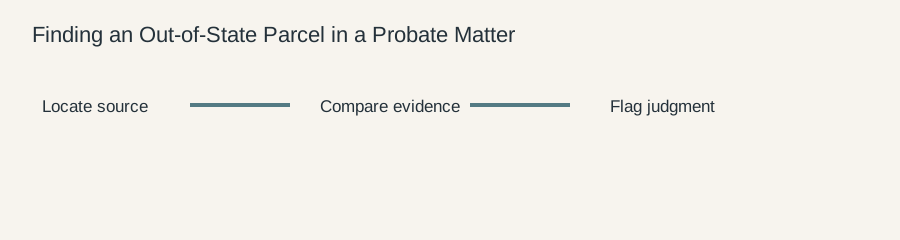
An out-of-state parcel creates a records problem before it creates a legal one. The home-state inventory may use a street address, a family nickname, or an estimated acreage. The foreign county may use a different parcel number, subdivision name, or legal description. A principal probate docket may mention the property without containing the local deed. The researcher’s job is to connect the clues, preserve the differences, and identify which local filing or professional review is still needed.
This is a property-research workflow, not advice about ancillary probate, title, taxes, or interstate jurisdiction. The Maryland Register of Wills | Estate Search, Probate, & Information and Maryland Register of Wills | Estate Search, Probate, & Information were checked for access context.
Start with the home-state clue
Extract the exact inventory description, decedent name, known co-owner, address, county or state, estimated interest, and source of the lead. A family email, tax bill, deed copy, appraisal, insurance policy, and probate petition have different evidentiary roles. Preserve the original wording and create a research proposition: “Does the parcel described in the home-state inventory correspond to a recorded interest in County B?”
Do not begin by assuming the state. A road name can exist in several counties, and a mailing address can point to a different county from the land. Use the state, county, parcel, and legal-description clues together. If only a nickname exists, search it as a lead and document the uncertainty.
Build an address-to-parcel crosswalk
Use the foreign county assessor, recorder, GIS, tax roll, plat index, and deed search. Start with the exact name and address, then add subdivision, lot, book and page, parcel number, or instrument number. Record which system supplied each identifier. A GIS label can locate a parcel but does not prove title. A tax roll can provide a historical account but may not show every interest.
Create one row per candidate parcel. Include legal description, parcel number, situs address, owner label, acreage, source date, and match rationale. Mark the row supported, possible, conflicting, or not located. Do not merge two candidates because both use the same road name.
Worked example: the family name is not enough
Suppose the home-state inventory says “Blue Creek cabin, near County B,” and a family member supplies the decedent’s last name. The foreign county search returns three parcels with similar owner labels. One parcel has a matching spouse, another has the same street name, and the third has the acreage in an old appraisal.
The researcher should retrieve the appraisal source, compare the legal description, search the recorder for the decedent and spouse, and examine the tax history. If one deed contains a parcel number that matches the appraisal and the later tax account, that is stronger evidence than the surname alone. If the deed is unavailable, report the candidate and the missing source rather than selecting it as the estate parcel.
Now suppose the deed names a trust, while the inventory names the decedent individually. Preserve the capacity conflict. Request the trust deed, successor-trustee records, and any later conveyance if authorized. The researcher can connect documents; counsel decides whether the trust interest belongs in the probate administration.
Search the foreign recorder separately
The home-state docket is not a substitute for the foreign recorder. Search grantor-grantee variants, entity names, parcel numbers, legal descriptions, instrument types, and date windows. Capture recorder division, online coverage, document number, recording date, and image availability. Search for deeds, affidavits, releases, mortgages, easements, death-related filings, and corrective instruments.
When the county uses a different index order, preserve the search form. If online records begin only in a recent year, document the archive request process. A zero result in the current portal is not evidence that an older deed does not exist.
Determine what the home-state case actually says
Read the inventory, petition, order, and accounting separately. A petition may assert that the decedent owned a parcel; an inventory may repeat that assertion; an order may address administration without resolving title. Quote the document and label its role. If the home-state docket references an ancillary filing, retrieve the foreign case number and court.
Do not infer that a foreign parcel was administered locally simply because it appears in the home-state file. Do not infer that it was omitted from administration because no local case was found. The next action may be a court-record request, title search, or counsel review.
Dates, interests, and partial land
Separate execution, recording, assessment, death, petition, order, and retrieval dates. Compare the deed’s legal description with the parcel at the relevant date. A parcel may have been split, combined, or renumbered. A sale may cover only part of the tract. A tax account may include improvements or land not included in the deed.
Capture ownership capacity, percentage or tenancy, easements, mineral reservations, life estate, trust language, and entity name. Do not calculate a value for a fractional or restricted interest without the appropriate professional method.
Handoff and source evidence
When the foreign county uses different terminology
Do not assume that “land records,” “register of deeds,” “clerk,” and “recorder” describe the same office. Confirm which office records deeds, which office keeps plats, and which court maintains probate filings. Save the custodian’s coverage statement. A search can be technically successful and still incomplete if it was run in the wrong series.
If a county uses a grantor-grantee index but the estate clue is a parcel number, search both directions where available. If older results lack parcel numbers, follow prior deed and plat references. Preserve each link and label where evidence becomes inferential. Distinguish “candidate parcel identified,” “recorded interest located,” and “professional title question resolved.”
When the records do not align
An out-of-state file often contains a tax address that differs from a deed address, a parcel suffix created after the decedent’s acquisition, or an appraisal that includes an adjoining tract. Treat each as a separate research branch. First compare the legal descriptions. Next check the plat and parcel history. Then identify the instrument or map that explains the change. If no document explains it, preserve both descriptions and report the gap.
Do not improve a source by silently correcting its county, acreage, or owner name. Put the corrected search form in a separate field and leave the source wording untouched. A later reviewer should be able to see whether the match came from a primary instrument, an assessor crosswalk, or a family lead. This distinction is especially important when the foreign county’s online index covers only recent years or excludes plats.
When a local court record is required, keep its case number separate from the home-state case number. A local filing may concern only a sale, only recognition of a representative, or only a title question. Read the operative order and compare it with the deed. A docket label is a pointer; it is not proof that every asset in the inventory was handled.
Preserve that distinction in the final summary.
Name the unresolved professional question.
Attach the supporting source.
Foreign-record search boundaries
State and county systems can divide deeds, plats, tax histories, and probate dockets among different custodians. Record each system separately and state its years of coverage. A candidate parcel is not a confirmed interest until the legal description and party capacity align. If the foreign county’s archive is not online, preserve the request path and explain that the absence of an online result is not a negative title finding.
Preserve the foreign custodian’s terminology in the source note so the next request uses the correct office and record series.
Use a state-by-state evidence matrix
For property outside the home state, create one column set per jurisdiction rather than treating “out of state” as a single status. Record the county, parcel identifier, recorded owner, tax account, local filing office, court case if any, and the question the local record can answer. A deed in State B may establish a transfer history while the home-state probate file only reports an estimated value. If the local search returns a different legal description, preserve both results and route the conflict for review. The matrix makes it clear which conclusion is supported locally and which remains dependent on the ancillary process.
Frequently asked questions
Is a tax address enough to identify the foreign parcel?
No. Use legal description and parcel cross-checks.
Does a home-state inventory prove ownership?
It is evidence of what was reported, not a title determination.
What if no foreign probate case is found?
Document the courts, indexes, names, dates, and limits searched; do not infer that no proceeding exists.
Who decides interstate filing or title effect?
Counsel, the title professional, fiduciary, or court process.