
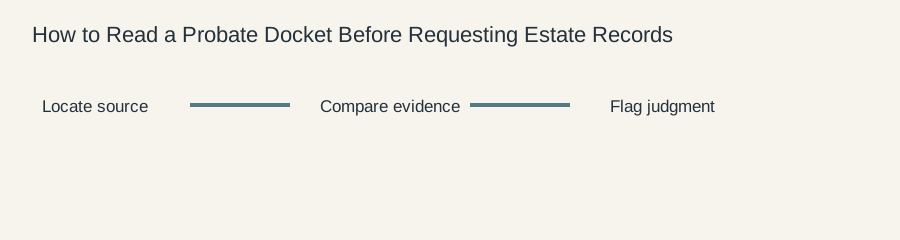
A probate docket is a chronology of filings and court events. It is useful because it tells a records researcher what case exists, who appears in it, which documents may be available, and what sequence the court has recorded. It is limited because a docket entry is usually not the pleading, order, inventory, accounting, or notice itself. Reading “petition filed” as though it were the petition’s requested facts, or “order entered” as though it proved every requested finding, can send a records request in the wrong direction.
This article describes a docket-first workflow for estate professionals. It is not legal advice, a statement of court procedure in every jurisdiction, or a conclusion about heirship or fiduciary authority. The What is PACER? | PACER: Federal Court Records were checked for general access context.
Establish the case identity
Capture court, county, division, case number, caption, filing date, decedent name, petitioner, and case type exactly as displayed. A probate caption may use an abbreviated name or an estate label that differs from a death certificate. Preserve both. Search neighboring case types only after confirming the jurisdiction’s terminology; a small-estate matter, guardianship, trust proceeding, or ancillary case may appear in a different series.
The case number is the strongest locator, but it does not prove that every document in the file is publicly available. Record whether the docket is current, historical, image-linked, or summary-only. Note access limits, sealed events, document fees, and whether the visible page is an official court system or a secondary index.
Read events as pointers
Classify each docket line as filing, notice, service, hearing, order, inventory, accounting, claim, distribution, appeal, or administrative event. Then request the underlying document when the distinction matters. “Inventory filed” tells you that an inventory event is recorded; it does not establish the inventory’s listed assets or values. “Order approving sale” points to an order whose terms should be read before describing the sale.
Create a chronology with event date, entry date if different, document title, document number, page or link, and research consequence. Filing date and hearing date answer different questions. A docket may display a date entered by the clerk rather than the date a party signed the document.
Worked example: a missing inventory
Suppose an estate docket shows “inventory filed” in March 2022 and “amended inventory” in September 2022. A records request asks only for “the inventory.” That request may produce the first document and miss the amendment. The docket suggests two separate productions. Retrieve both, identify what changed, and link each version to the asset schedule. Do not report the first inventory as final merely because it appears first.
Now suppose the docket says “account approved” but the accounting PDF is unavailable. The safe finding is that an approval event appears on the docket. It is not safe to state the approved receipts, expenses, or balance without the accounting and order. Ask the clerk how the document can be requested and flag the missing source for counsel or the fiduciary.
Distinguish petition, order, and outcome
A petition states what a party asks the court to do. An objection states a challenge. An order states what the court directed, subject to its actual text and procedural status. A docket entry may link one document but not another. Keep those roles separate in the request log.
When a docket says “letters issued,” retrieve the letters if authority must be verified. When it says “sale confirmed,” retrieve the confirmation order and the deed or closing record if property disposition matters. When it says “claim allowed,” distinguish the claim, allowance entry, and payment evidence. The event label is a research map, not a substitute for the source.
Use the docket to design requests
List the document families suggested by the chronology: petition, will, death certificate, notice, proof of service, inventory, appraisal, claims, accounting, order, deed, bond, letters, and distribution. Request by case number and event date. If the court uses document numbers, include them. Ask for attachments and exhibits when the docket indicates they exist.
Do not ask the clerk to answer a legal question that belongs to counsel. Request the document and metadata. “Please confirm that the heir received the property” should become “please provide the distribution order, receipt, or filing associated with the docket event dated July 8.” The professional then evaluates effect.
Handle gaps and sealed events
A gap between events does not prove that nothing occurred. The court may have a sealed filing, a separate register, a minute entry, or a document awaiting scanning. Record the visible event, the missing link, the custodian contacted, and the response. If access is restricted, identify the restriction without guessing its contents.
If the docket changes after retrieval, save the retrieval date and compare the earlier and later views. A corrected event or added image should be treated as new evidence. Do not delete the earlier capture if the work requires an audit trail.
Compare the docket with other records
Use the probate docket to connect, not replace, other sources. A deed can test whether an order’s property description matches the conveyance. A death certificate can support the identity and date of death, but not the petition’s legal conclusions. An assessor record can help locate a parcel, but it does not prove what the court ordered. Preserve source roles in the evidence table.
Conflicting dates should be labeled rather than averaged. A petition may be signed May 1, filed May 4, heard June 7, and ordered June 14. Each date has a different meaning. A docket’s shorthand may need the complete order before it can be summarized.
Final handoff
The docket packet should contain case identity, saved chronology, document requests, retrieved filings, source URLs or file paths, access limitations, contradictions, and open questions. State facts first, analysis second, and professional decisions third. An accessible diagram for this article should show docket event, underlying document, independent cross-check, and unresolved branch; alt text should describe the same sequence.
Reading procedural posture without overclaiming
The docket’s order is itself evidence about sequence, not necessarily about success. A petition can be filed and later withdrawn. A hearing can be continued. An objection can be resolved by an agreement that is not visible in a one-line register. When the file matters to a property or distribution question, preserve the event history and request the operative paper. If the document cannot be retrieved, write the conclusion at the docket level: “the register displays an event,” not “the court determined the underlying facts.”
Use the same discipline for parties. A person listed as petitioner may be a representative, creditor, beneficiary, or another permitted filer. A party name in a caption is not automatically proof of relationship. Compare the petition, appointment order, and letters before describing someone as executor or administrator. If the docket uses an abbreviation, keep it and identify the document that could clarify capacity.
For a property request, add the parcel identifier and document number to the docket log. That prevents a similarly captioned case from being mistaken for the proceeding tied to the estate’s land.
Keep the case number in every request and saved filename.
This keeps court, parcel, and production references connected.
It also lets a reviewer distinguish a missing court document from a missing property record.
Use docket events to request the right paper
A docket is most useful when it changes the next request. An inventory event suggests asking for the inventory and attachments; an amended inventory suggests requesting both versions; an order approving a sale suggests retrieving the operative order and deed. Preserve the event number and date. If the event is visible but the document is sealed or unavailable, state that boundary rather than inferring its contents.
Read docket entries as an event sequence
A docket is an index of court activity, not a substitute for every filed document. Start with the case number and filing parties, then place petitions, notices, orders, inventories, and closing entries on a timeline. If an entry says an order was entered but the order image is absent, record the entry as evidence that the docket reports an order, not as proof of the order’s full terms. In a worked review, a petition identifies a parcel but a later inventory omits it; the discrepancy should trigger retrieval of the filed inventory and any amendment rather than an assumption that the omission was intentional.
Frequently asked questions
Does a docket entry prove the facts in a filing?
No. It proves that the docket displays the event. Retrieve and read the filing.
Does “order entered” show the entire ruling?
No. The operative order and any attachments are needed.
What if an expected document is missing?
Record the event, contact the custodian, preserve the response, and state the limitation.
Can a researcher decide what an order means legally?
No. Organize the document and flag the question for counsel or the responsible professional.