
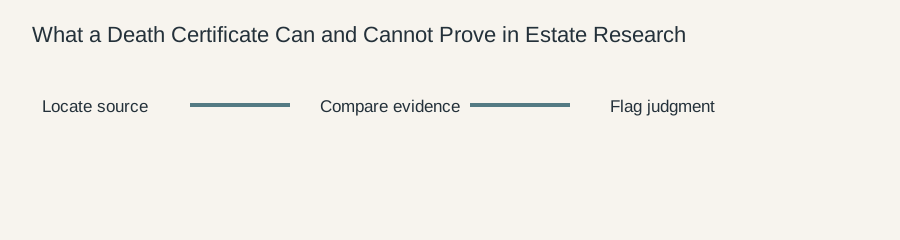
A death certificate is often the first document that connects a person, a date, and a jurisdiction in an estate file. It can be essential for opening a probate case, transferring an account, or locating a recorded affidavit. It is also frequently asked to prove facts it was not designed to establish: title to land, the complete list of heirs, validity of a will, domicile for every tax purpose, or the balance of a financial account. Good estate research uses the certificate for the propositions it supports and labels everything beyond those propositions as a separate question.
This article is a records method, not vital-records legal advice. Access and correction rules vary by jurisdiction. The Where to Write for Vital Records - Homepage and Where to Write for Vital Records - Homepage were checked as examples of court and tax context; neither source establishes facts about a particular decedent.
Identify the proposition before using the certificate
“The death certificate proves the decedent died on June 4” is a different proposition from “the death certificate proves the decedent owned the Oak Road parcel.” The first is generally a record fact if the document is authentic and complete. The second does not follow. Write the requested proposition in the evidence log and identify the document that could actually test it.
Capture the certificate’s issuing authority, certificate number, registered date, date and place of death, legal name as displayed, age or date of birth if shown, informant, and any amendment indicator. Preserve the original spelling. A transcribed summary or obituary may help locate the certificate, but it is not the same source.
Understand informant limits
Many certificates contain information supplied by an informant or a medical certifier. The informant may know the person well, but may not know the complete legal history of property, prior names, or every family relationship. Treat those fields according to their origin. A place-of-residence field can be a lead for a probate jurisdiction; it is not automatically proof of domicile for every legal purpose.
An occupation, marital status, parent name, or address can be useful for identity resolution. Record it as displayed and cite the field. Do not silently correct a spelling or infer that an omitted spouse was not married. If the certificate conflicts with a probate petition, deed, or identity record, preserve the conflict and ask which source is authoritative for the specific question.
Worked example: identity and property are different questions
Suppose a certificate names “Eleanor M. Price,” gives a death date, and lists a residence at 12 Oak Road. The estate inventory also lists 12 Oak Road, while the recorder’s deed names “Eleanor Price Revocable Trust” as grantee. The certificate strongly helps connect the person and address. It does not prove that Eleanor individually owned the land at death. The trust deed, amendments, successor-trustee documents, and title review address the ownership question.
A second example involves a certificate that spells the surname “Gonzalez,” while an older deed uses “Gonzales.” The certificate may support an identity hypothesis when the address, spouse, parcel, and date also align. It should not be used to overwrite the deed’s spelling. Preserve both forms, search the variant, and state which independent record connects them.
Date fields require labels
Separate date of death, registration date, issue date, amendment date, and retrieval date. A certificate issued years after death may still document the original event, but the issue date is not the death date. An amended certificate may change a field without erasing the history of the earlier version. Save the version and amendment information when the distinction matters.
Compare the certificate date with deed execution, deed recording, account closure, probate filing, and tax reporting dates. A death date can establish a chronology boundary, but it does not automatically establish when an asset transferred or what value applied. Those are separate professional questions.
Use the certificate as an identity crosswalk
Build a crosswalk with name variants, birth date, death date, last address, county, spouse or informant, certificate number, probate case number, parcel number, and independent source. The certificate is one row. A probate caption, recorded deed, assessor account, obituary, and court order are other rows with their own limitations.
When two records conflict, ask whether the conflict is material to the proposition. A missing middle initial may not matter if the parcel and spouse match; a different date of birth may require deeper investigation. Do not use a confidence score without stating the evidence behind it. “High confidence” is not a substitute for a quoted identifier.
Access and privacy are part of the method
Vital records may have restricted access, redaction, or different rules for certified and informational copies. Record what type of copy was reviewed and who supplied it. Do not place unnecessary personal information in a public article, shared screenshot, or broad email. Keep controlled copies under the organization’s privacy and retention policy.
If the certificate cannot be obtained, record the custodian, eligibility requirement, request date, response, and next action. An obituary or funeral-home notice can be a locating lead, but it should be labeled as secondary. An unavailable certificate is not permission to present a secondary source as a certified fact.
What it cannot establish by itself
The certificate alone generally cannot establish legal title, the validity of a will, complete heirship, survivorship rights, beneficiary designations, debt responsibility, appraisal value, or tax inclusion. It may be one required item in a process, but the process has other evidence. Route those questions to counsel, a fiduciary, a tax professional, or another appropriate decision-maker.
The certificate also does not prove that every record naming the person belongs to the same person. Namesakes, prior surnames, transliteration, and indexing errors remain possible. Use independent identifiers and preserve uncertainty.
Testing a disputed identity
When the certificate and another record appear to describe different people, build a side-by-side chronology rather than choosing a spelling. Compare birth date, last address, spouse or informant, occupation, parcel history, and the dates on the surrounding records. A matching death date is useful but not unique. A matching address may reflect a residence, a mailing address, or an informant’s knowledge. State which details are independent and which were copied from the same source family.
If a correction or amended certificate exists, preserve both versions and identify the field that changed. Do not assume the later version makes every earlier record wrong. Ask the issuing authority’s instructions or counsel what the amendment establishes. The research conclusion should identify the exact conflict, the best available corroboration, and the professional question still open.
This approach matters when a certificate connects a person to a parcel or financial account. Describe that connection as a crosswalk supported by multiple records, never as a conclusion derived from one vital record alone.
A defensible handoff
The handoff should quote the relevant certificate fields, identify the issuing authority and version, list corroborating records, state conflicts, and separate facts from analysis. Include a chronology with labeled dates and a next-action list. If the certificate was used only to locate a probate file or parcel, say that plainly.
Also identify whether the reviewed copy is certified, informational, amended, or an image supplied by another party. Copy type affects how confidently a professional can use it and tells the next reviewer what document to request.
Certificate copy and amendment history
Record whether the copy is certified, informational, amended, or supplied by another party. A changed field should be linked to the amendment rather than silently replacing the first version. The certificate can support an identity and event chronology, but property, heirship, and tax conclusions require their own records and professional analysis.
Treat the certificate as one record in a corroboration set
If a death certificate lists an address or occupation that differs from a deed or account record, preserve the discrepancy rather than selecting the version that fits the inventory. Compare the certificate’s informant, date, jurisdiction, and stated purpose with the source that supplies the competing fact. A certificate can support a death-date proposition while leaving ownership, domicile, or beneficiary questions unresolved. In the handoff, identify the exact field relied upon and name the independent record needed to test the other proposition. This prevents an administrative record from being stretched into evidence it was not designed to provide.
Frequently asked questions
Does a death certificate prove who inherits?
No. It may identify the decedent and event; heirship and will questions require the governing process and professional review.
Does the listed address prove domicile?
It is evidence about the address reported on the certificate. Its legal significance depends on the question and other records.
Should a spelling conflict be corrected?
Preserve the original forms and explain the identity analysis. Do not rewrite source evidence.
What should be cited?
The issuing authority, certificate or copy type, certificate number where appropriate, relevant field, version or amendment, and retrieval date.