
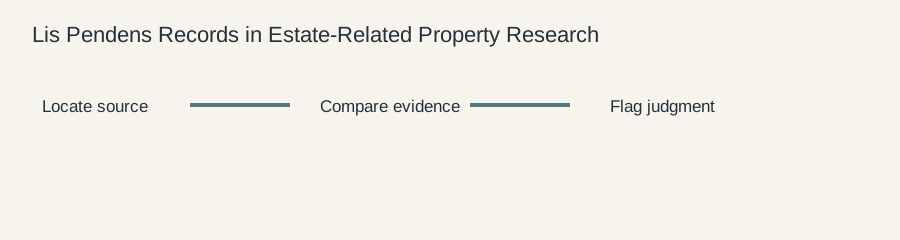
A lis pendens is a notice connected to a pending action affecting real property. In an estate file, finding one can explain a stalled sale, a title objection, an ownership dispute, or a parcel that appears in litigation rather than in an ordinary conveyance. It is not itself a judgment, proof that a claimant will win, or a substitute for the complaint and docket. The lis pendens | Wex | US Law | LII / Cornell Law School was checked and is a general legal reference; local recording and notice rules control a particular matter.
This research article describes how to locate, read, and report a lis pendens without overstating what the notice establishes. The researcher’s task is to connect the notice to a parcel and proceeding, preserve the filing facts, and expose uncertainty. Counsel decides the legal effect, notice consequences, settlement strategy, and whether the filing remains operative.
What the notice tells you first
Start with the instrument number, recording date, recording county, plaintiff and defendant names, case number, and legal description or parcel identifier. Those fields answer a locating question: which public filing should be retrieved and which court matter should be opened? They do not answer the merits question. A notice can identify a lawsuit without proving the allegations in the complaint.
Create separate columns for execution date, acknowledgment date, recording date, case filing date, and any release, withdrawal, dismissal, or final judgment date. A title report may present one date prominently, while the court docket shows another. A sale timeline needs those distinctions. The phrase “lis pendens date” is too vague for an auditable research log.
Connect the notice to the right parcel
Street addresses are useful for orientation but weak as the primary key. Compare the notice’s legal description with the deed, assessor parcel number, plat, and current title record. A metes-and-bounds description may not resemble a condominium unit label. A parcel may have been split or combined after the notice was recorded. Preserve the original description and record the mapping analysis separately.
Consider a hypothetical notice naming “Lot 14, Block B,” while the estate inventory lists 18 Cedar Lane and the current assessor lists parcel 71-04-014. The safe workflow is to obtain the plat, match Lot 14 to the parcel, and check whether a later split created 71-04-014A and 71-04-014B. Do not conclude that the notice burdens both new parcels merely because they share an address. Ask title counsel how the recorded description carries forward.
Read the notice as a pointer, not a decision
The notice may identify the nature of the action in broad terms, but the complaint, answer, motions, orders, and docket supply the procedural context. Retrieve the court record if available. Note whether the action seeks specific performance, partition, foreclosure-related relief, quiet title, boundary relief, or another remedy. These labels help route the file; they do not establish that the requested remedy is available or likely.
For each source, write a factual note and a separate interpretation. Fact: “Instrument 2025-00418 was recorded in County A on March 4, 2025, names the parties, and describes Lot 14.” Interpretation: “The notice is potentially relevant to the parcel identified in the inventory.” Uncertainty: “The saved notice does not show whether the action was dismissed, released, or resolved.” This division prevents a docket lead from becoming a title opinion.
Worked example: an apparent sale obstruction
Assume a personal representative has a contract to sell a house. A title search returns a lis pendens recorded three years earlier by a person whose surname resembles the decedent’s. The notice describes a tract by an old lot-and-block reference. The inventory uses a street address, and a later deed shows the estate as grantor.
The researcher should first preserve the notice, then match its legal description to the deed and tax parcel. Next, retrieve the complaint and docket using the case number. Suppose the docket shows a dismissal but no recorded release. That supports a factual statement that the court docket contains a dismissal entry; it does not automatically answer whether a title company needs a separate release or court order. The handoff should send that question to title counsel and identify the missing operative document.
Now suppose the docket shows the case is still pending, while the notice names an earlier owner and the current parcel was created by a subdivision. The result is more complex, not less. Preserve the subdivision map, identify the tract relationship, and ask counsel whether the pending action reaches the new parcel. Do not clear the issue because the named party is no longer the current owner.
Search the recording office and court separately
A county recorder’s index and a court docket answer different questions. The recorder can show whether a notice, release, or related instrument was recorded. The court can show pleadings, orders, and status events. Search both systems with the instrument number, case number, party names, parcel identifier, and date window. Save zero-result searches and note access limits, including image restrictions or docket fields hidden from public view.
If the county has multiple recording divisions, document which division was searched. If the court uses a different case-number format, preserve the converted form and the original. If the action was filed in one county but affects property in another, ask counsel whether an additional local recording was required; do not infer compliance from the existence of one notice.
Follow the status trail
Status is not a single field. Build a chronology: complaint filed, notice recorded, service or appearance if visible, amended pleading, temporary order, settlement or dismissal, final judgment, appeal, release, and later conveyance. Mark each event with its source and date type. A docket abbreviation may be a lead that requires the filed order.
The absence of a release in the recorder search is not proof that the notice remains effective. Conversely, a docket dismissal is not automatically proof that every recording consequence has been removed. The report should state both observations and identify the professional question created by their interaction.
Common analytical errors
The first error is calling a lis pendens a lien. Its legal function and effect vary by jurisdiction; use the local terminology and ask counsel. The second is treating the allegations in a complaint as adjudicated facts. Quote allegations as allegations. The third is matching by street address alone. The fourth is assuming that an old filing is irrelevant because the estate acquired the parcel later. The fifth is omitting the search for releases, withdrawals, amended notices, and final orders.
The sixth error is using a search-result snippet as the source. Retrieve the official image, docket entry, or filed pleading whenever possible. Record a stable URL or custodian path, the retrieval date, and the document identifier. If access fails, state exactly what could not be retrieved.
A reproducible research packet
The packet should include the notice image or official text, recorder metadata, court docket and key filings, parcel crosswalk, chronology, search terms, result counts, related instruments, and unresolved questions. Include an accessible diagram showing the relationship between notice, parcel, court file, and status event; the accompanying alt text should describe the same relationships in words. Do not use a generic property thumbnail that could imply a conclusion.
Questions for counsel
Ask whether the notice affects the contemplated transaction, whether a release or court order is required, whether the parcel crosswalk is legally sufficient, and whether the procedural posture changes the estate’s disclosure or closing obligations. Supply the documents and chronology rather than an answer disguised as research.
Status requires two record systems
The recorder may show the notice and a later release while the court docket shows pleadings, dismissal, appeal, or an unresolved matter. Search both systems and compare dates. A docket dismissal does not automatically answer every recording question, and a recorded notice does not prove the allegations. Preserve the status chronology for title counsel.
Frequently asked questions
Does a lis pendens prove the claimant owns the property?
No. It signals a pending property-related action; ownership and merits require professional and, where applicable, judicial analysis.
Is a dismissal enough to clear the public record?
Not necessarily. Compare the docket with recorder records and ask counsel what documentation the transaction requires.
Can a street address identify the affected land?
It can help locate the parcel, but the legal description and parcel crosswalk should control the research note.
What is the safest conclusion?
State what was recorded, what the court file shows, what status remains uncertain, and which professional decision is next.