
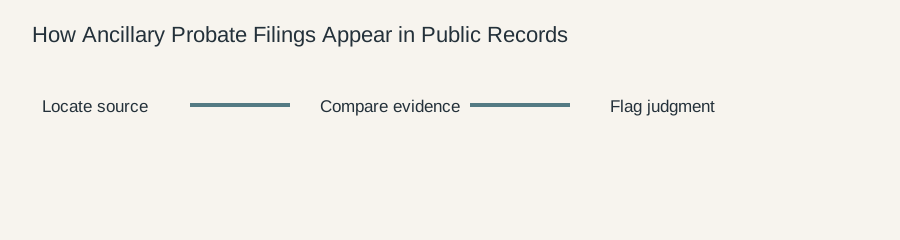
For records research, use “ancillary” as a working label for a local estate proceeding that appears related to administration elsewhere; confirm the jurisdiction’s own terminology before treating that label as a legal classification. Maryland’s public Estate Search uses the label “Foreign Proceeding (FP)” for a decedent domiciled out of state with real property in Maryland. A record set may contain a petition, authenticated appointment, notice, letters, sale order, or closing filing. One event does not prove completion, recognition of a foreign appointment, or disposition of a particular parcel.
This article provides a records-research method, not advice about jurisdiction, recognition, title, notice, or filing strategy. The Case Search — Frequently Asked Questions supplies Maryland’s search label and visible docket fields; it does not establish the legal effect or filing sequence in a particular case. Local court rules, the actual filings, and counsel control the legal analysis.
Recognize the two-case relationship
Begin by recording the principal case number, court, decedent name, personal representative, date of death, and the local property or asset. Then record the ancillary case number, court, caption, filing date, and relationship stated in the public record. Do not assume that similar captions are connected. A local case may be a separate probate, a creditor matter, a title proceeding, or a later filing by a purchaser.
Create a relationship table with principal event, local event, source, identifier, date type, and documentary consequence. “Ancillary petition filed” is an event. “The local court accepted the foreign appointment” requires the petition, order, and applicable professional interpretation.
Search the property first
For land, use the recorded legal description, parcel number, deed history, and county. The street address alone is insufficient. Search the recorder for deeds, foreign personal-representative instruments, affidavits, notices, orders, and releases. Search the court docket separately. A deed may be recorded locally without the complete probate file being available online; a docket may show an order without an image of the deed.
Preserve the exact capacity of each signer. “Personal representative of the estate of” is not the same as individual ownership. A trustee, heir, purchaser, and administrator may appear in related documents. The capacity field is a research fact, not a conclusion about authority.
Worked example: a home-state order and an out-of-state tract
Suppose a decedent lived in State A and the principal probate docket shows letters issued there. The inventory lists a tract in State B. A State B docket shows a petition to admit a foreign will and later an order authorizing sale. The State B recorder shows a deed from the personal representative to a buyer, but the deed’s legal description covers only one of two parcels listed in the inventory.
The safe research result is split. The court records show a local petition and sale-order event. The deed identifies the conveyed parcel. The second parcel remains a separate question. Retrieve the order, petition exhibits, plat, and prior deed; compare descriptions and ask counsel whether the local proceeding addressed both parcels. Do not report that “the ancillary case transferred the estate property” when the documentary set shows only one conveyance.
Follow the filing sequence
A useful chronology may include foreign judgment or will authenticated, ancillary petition filed, notice issued, objection or waiver, local appointment or recognition order, bond, inventory, sale petition, sale order, deed, accounting, and closing order. Each jurisdiction uses different labels. Quote the local label and explain the research meaning cautiously.
A notice event is not proof of service on every interested person. An order authorizing sale is not the same as a recorded deed. A recorded deed is not a complete account of consideration or distribution. Ask for the document behind each event that matters to the proposition.
Compare principal and local records
Check names, dates, capacities, descriptions, and authority across both proceedings. A principal court may appoint a representative using a spelling or suffix that differs from the local petition. Preserve both forms and use independent identifiers. If the local file cites a principal order, retrieve the cited order rather than assuming the citation is accurate.
Look for limits. A local order may address only the identified parcel, only a sale, or only recognition of an appointment. An order may be superseded, appealed, or followed by a corrected filing. A closing entry may show the court’s administrative status without proving that every asset was distributed.
Missing documents and access limits
If the local docket shows a petition but no attachment, record the docket event, missing item, custodian, request date, and response. If the court requires a certified copy from the principal jurisdiction, record that requirement. If a recorder image is unavailable, label the instrument as index-only. Do not call a case incomplete merely because a public portal hides a document; state what access boundary was observed.
A negative search should include county, court division, case number, party variants, parcel identifier, date range, and result. Searching the principal case alone is not a search of the ancillary court. Searching a local recorder is not a search of the local docket.
Ask separate questions about recognition and disposition
In a hypothetical file, a docket label such as “foreign will filed” raises a document question: is there an authenticated will, petition, or order behind the label, and what jurisdiction does that document name? A separate question asks whether any order addresses a sale or appointment. Do not treat the label as an answer to either question.
In another hypothetical file, a deed appears after an entry described as an order. Retrieve the order and deed separately and ask whether their parcel descriptions, capacities, and dates actually connect. A public record may leave accounting or distribution materials unavailable; report the missing material rather than inferring the result. Keep recognition, authority, sale, conveyance, and closing as separate propositions, each tied to its own document and jurisdiction.
When a local docket uses a shorthand such as “foreign judgment filed,” retrieve the judgment and identify its issuing court, date, and scope. A filed judgment may be an attachment, not an operative local order. If the local record cites a certified copy, preserve the citation and request the copy through the stated process. Do not infer the contents of a missing attachment from the docket label.
The same discipline applies to notices. Record the event, recipient or publication information if visible, and document type. A notice can show that a procedural step was attempted or recorded; it does not prove that every interested person received it or waived an objection. Those are questions for counsel and the court record.
Reconcile the local property file
Compare the ancillary petition’s parcel description with the deed’s description, current tax account, plat, and prior conveyance. If the inventory says “the farm” but the local petition names a legal description, do not assume the label covers every tract. Create one row per parcel or interest. Note acreage, easements, mineral reservations, and partial interests as separate documentary features.
If a property was sold before the ancillary filing, the local case may still contain later recognition or title work. Preserve the chronology rather than assuming that the filing caused the transfer. A professional can then decide whether the local proceeding affected notice, marketability, or accounting.
Keep this chronology with the saved docket and recorder references so a later reviewer can reproduce the cross-jurisdiction comparison.
Record the retrieval date, document identifier, and any access limitation beside each event. That preserves the distinction between an observed filing and an inferred procedural consequence.
Preserve documentary identifiers
Keep each docket, petition, order, deed, and source request tied to its court, case number, filing date, parcel reference, and document identifier. This record-level labeling lets a later reviewer distinguish an observed filing from an inference about recognition or disposition.
Recognition, sale, and closing are separate questions
For each observed docket or document, record the narrow proposition it can answer: whether a filing is visible, whether an order is available, whether a deed is recorded, or whether a closing entry is displayed. Then record the proposition it cannot answer without another document, such as whether an appointment was recognized, land was conveyed, or distributions were completed. This prevents a foreign case number from becoming a blanket conclusion about every asset.
Keep the principal and local case identifiers in every source filename and request so the proceedings cannot be silently conflated.
Distinguish a filing pattern from a jurisdictional conclusion
A local docket can show that an ancillary matter was opened, amended, or closed, but the observed sequence does not by itself establish that every out-of-state asset required the same procedure. Record the court, case identifier, filing type, date, parcel reference, and document availability. If one case includes a real-property schedule and another does not, report the difference and investigate the underlying orders before treating it as a practice rule. The useful research result is a documented pattern with limits, not a universal statement inferred from a small set of dockets.
Frequently asked questions
Does a principal probate appointment automatically control local land?
Do not assume so. Research the local filing and ask counsel about recognition and title effect.
Does an ancillary docket prove a parcel was sold?
No. Locate the operative order and recorded deed, then compare their descriptions.
What if the two cases use different names?
Preserve both forms and corroborate with case numbers, dates, addresses, and source documents.
Who decides whether the local proceeding is sufficient?
The responsible attorney, title professional, fiduciary, or court process. The researcher organizes the records.