
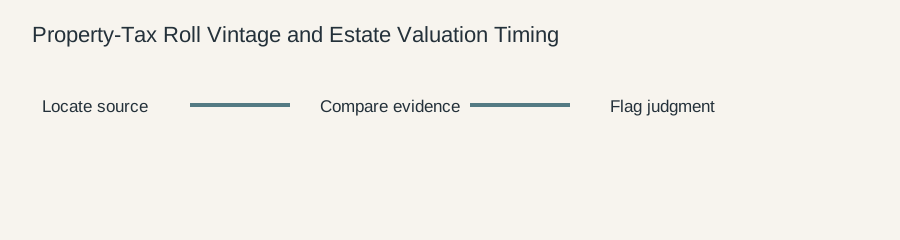
A property-tax roll can be an efficient way to locate a parcel, owner label, assessment, exemption, or tax account. It is often misused as though its year were automatically the value date for an estate. Tax systems use their own assessment cycles, levy years, effective dates, corrections, and statutory methods. A roll may be relevant evidence without being an appraisal or a direct measure of fair market value on the date an estate professional needs.
This article explains how to research the vintage and meaning of a tax-roll record. It is not appraisal, tax, title, or legal advice. The Instructions for Form 706 (Rev. September 2025) was checked for federal estate-reporting context. The IRS source does not convert a local assessment into a required estate value.
Label the year precisely
Do not write only “2024 tax value.” Capture assessment year, levy year, bill year, tax period, valuation date if stated, certification date, correction date, and retrieval date. A county may assess property on a date before the tax bill is issued. A bill may be paid in a later calendar year. A corrected roll may supersede an earlier figure without changing the underlying assessment date.
The roll’s year is therefore a field to interpret, not a conclusion. Retrieve the county’s explanatory page, assessment calendar, or official definition when available. Save the source wording with the record. If the portal does not explain the year, say that the meaning was not verified rather than assuming it.
Start with the parcel, not the amount
Use the parcel number, legal description, and owner label to identify the record. A street address can change; a parcel can split or combine; an account can be renumbered. Compare the roll with the deed and assessor history. If the legal description differs, create a discrepancy row before comparing values.
Extract land value, improvement value, total assessed value, taxable value, exemptions, classification, acreage, and any market or appraised field separately. “Total” may combine components that are not comparable to a professional appraisal. Preserve the exact label used by the assessor.
Worked example: assessment year versus death date
Suppose a decedent died in February 2024. The 2024 tax roll lists a total assessed value of $310,000, certified in July 2024. The estate file asks for a date-of-death real-property value. The roll is useful for identifying the parcel and showing the public assessment, but it does not by itself answer the valuation request. It may reflect a statutory cycle, a prior valuation date, or a classification that differs from the estate’s question.
The researcher should obtain the roll’s valuation-date definition, prior and subsequent rolls, transfer history, and any public appraisal field. Then present the records to the appraiser or tax professional. If the 2024 figure is used as context, label it “2024 assessment as reported by the county,” not “date-of-death value.”
A second case involves a corrected 2023 roll issued after the owner’s death. The corrected entry changes the improvement value but not the parcel number. Preserve both roll versions and the correction notice. Ask which version the county treats as operative and whether the correction has any bearing on the professional valuation question.
Understand assessment, taxable, and market fields
An assessed value may be calculated under a local ratio or statutory cap. A taxable value may subtract exemptions or limits. A market, appraised, or estimated value may have a separate definition. Do not use the largest or most convenient number as the estate value. Copy the field names and explain what the source says each means.
Exemptions can be especially misleading. A homestead, agricultural, senior, disability, or historic exemption may reduce taxable value without changing the underlying land or improvements. A classification can indicate use, not ownership. Preserve the exemption code and effective period when it matters.
Compare multiple vintages carefully
A year-over-year table can reveal a transfer, improvement, parcel change, correction, or exemption change. It cannot explain the cause by itself. For every material change, check deed records, permits, parcel history, assessor notes, and the tax office’s explanation. A steep increase may reflect a new assessment cycle rather than a sale; a decrease may reflect an exemption or correction.
Use a table with parcel number, description, assessment year, valuation date, land, improvements, total, taxable amount, exemptions, source URL, and notes. Keep numbers in source currency and units. Do not calculate a percentage change until you know that the compared fields and parcel boundaries are the same.
Separate facts from valuation analysis
Fact: “The county portal displays land value of $120,000 and improvement value of $190,000 for parcel 11-22-014 on the 2024 assessment roll.” Analysis: “The record may help corroborate parcel identity and public assessment history.” Uncertainty: “The portal’s valuation-date definition and any later correction have not been verified.” Professional question: “Is this evidence appropriate for the requested estate valuation?” This format prevents a public number from being presented as an appraisal.
If the roll is unavailable, document the custodian, search terms, date range, portal limitation, and request. A missing online record does not prove that the county has no historical roll. Request archival or certified material when the matter requires it.
Handoff and accessible presentation
Reconciling a roll with a professional valuation question
The valuation handoff should state the requested date, the property interest, the source vintage, the field labels, and the reason the roll is relevant. If an appraiser needs comparable sales, an assessment roll is not a substitute for a sales study. If a tax professional needs a reported value, the roll may be one corroborating item but the filing instructions and valuation method control. If counsel needs to identify the parcel, the roll may be useful with the deed and plat while still saying nothing about marketability.
Keep calculations reproducible. If you compare two vintages, show the source values, units, parcel boundaries, and formula. Do not round a value before recording the source amount. Explain whether a change reflects an actual source statement, a derived percentage, or an analyst’s interpretation. That distinction lets another reviewer correct the analysis without changing the public record.
When a roll includes both assessed and taxable fields, preserve both and explain any exemption or cap shown by the assessor. A lower taxable amount may be an administrative result rather than evidence that the land or improvements declined in market value. Likewise, a sudden increase may reflect a reclassification, new construction, parcel combination, or correction. Check the assessor’s notes and related instruments before assigning a cause.
If the professional needs a value for a date the roll does not cover, state the gap directly. Do not interpolate a value from two rolls unless the responsible professional requests a documented analytical method. The researcher’s contribution is a reliable source chronology and parcel crosswalk.
That limitation belongs in the final memo, not only in an internal note.
It should also appear beside the cited roll field.
When a source is corrected, preserve the earlier value and explain the correction rather than silently replacing the number. The chronology is part of the evidence.
Explain the roll’s field definitions
Assessment, taxable value, market estimate, exemption, certification, and levy fields can coexist in one county record. Preserve the assessor’s definitions and compare only like fields. If the estate needs a date the roll does not cover, state the gap and route it to the appraiser or tax professional rather than interpolating an unsupported value.
The source field label and assessment calendar belong beside every copied number. Always. Document them.
Reconstruct the assessment calendar before comparing years
An assessor’s “2023” label may refer to an assessment year, tax year, certification year, or publication year. Record the field label and the calendar definition supplied by the jurisdiction. For example, a roll certified in February may describe an assessment made the prior January, while a later correction may carry the same roll year. Compare like fields and preserve the retrieval date. If the estate question concerns a date not represented by the roll, identify the missing valuation evidence instead of interpolating between adjacent years. That limitation is part of the result, not an editorial footnote.
Frequently asked questions
Is a tax assessment an appraisal?
No. It is a local assessment record with its own purpose and method.
Can the roll identify the property?
Often it helps, especially when matched to parcel and legal-description evidence, but the crosswalk should be documented.
Does the year equal the date of death?
No. Label the assessment, levy, certification, and valuation dates separately.
Who decides whether the roll supports a tax filing?
The responsible tax professional, appraiser, attorney, or fiduciary.